|

|
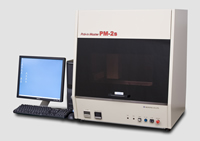
Desktop
size colony picker: PM-2s
|
- Compact Desktop Size
- Full Automatic Colony Picking System
- Automatic Needle Change System (ANCS)
- 6 Million Pixel High Resolution Camera
- Automatic storing of colony-picking/transferring data in Excel
format
- Retail price in Japan: Inquire us.
|
- Contamination-free automatic colony transfer
- Effective use of your time, and improved work efficiency
in your laboratory
- Reduced labor hours for routine tasks and the risk of
RSI(repetitive stress injury) among scientists
|
Features:
- The system is equipped with a 6 million pixel high resolution
CCD camera able to handle E.coli, yeast, plaques, molds, bacteria,
phages etc.
|
Captured image
of 90 Ø dish in high resolution.
It may take a little time to download. |
- The extremely compact size of 670 mm x 520 mm allows setup
of the system on the laboratory table.
- Microtec's original automatic needle change system (ANCS)
and the triple sterilization reduce the risk of contamination
to a minimum.
- Color image identification realizes high-precision processing
steps including primary colony identification, restriction,
color selection and picking.
- A dedicated software refined through extensive experience
supports marked scalability and multifunction as a standard
specification.
|
Screen Shots
Advanced
software
A large body of parameter data has been gathered through extensive
experience. The models of the Microtec PM-2 series come with a built-in,
highly advanced multifunction software. Using various parameter
groups it is possible to store a highly customized set of parameters
for unique protocols.
| Parameter Settimg |
 |
- Microplate setting (96, 384, 96deep well)
- Number of needle oscillations
- Picking conditions
- Setting starting position(
)
and blank wells( )
- Needle sterilization parameters
- Depth of needle insertion
- Replica plate settings
|
| Colony identification screen
|
 |
|
Automatic identification
- Arbitrarily set the identification scope so as to allow automatic
24 bit RGB temporary identification.
- Set the distance to adjacent colonies, ratio of long to short
ellipsis diameter, roundness, minimum - maximum number of pixels
and various other parameters for refining.
- Automatic operation
After completion of the operation, the picking data will automatically
be stored in the PC and operation then terminated. A chime announces
the end of the operation.
- After completion of automatic operation
The <screen to view transfer results> allows to crosscheck
dishes and microplates by observing the image.
|
Hardware
Compact desktop size
672 mm (W) x 523 (D) mm x 720 mm (H), requiring only 70% of the
installation space of other models of our company. The front door
has a large opening covering about 70% of the front and the door
is stored in the upper portion of the machine, providing a wide
working area. Also, because the machine operates entirely on a
100 V AC power supply, it can easily be installed on a laboratory
table.
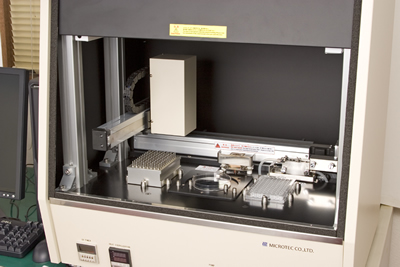
Automatic needle change system
<A.N.C.S.>
 |
The dedicated needle pin set in the machine
can be automatically replaced by the robot during the colony
picking. The unique mechanism of so-called <Automatic Needle
Change System (A.N.C.S.)> allows to limit cross contamination
to a minimum. Moreover, since the main unit has originally
been equipped with triple sterilization system using brushing
+ ethanol rinse + 400°C heating sterilization, it allows
sterilization during the process of colony picking. |
Comprehensive basic equipment
Sterilization of the work stage with a timer controlled UV lamp,
a 400 degree heater with temperature control, one-touch changer/holder
for Ø90 and Ø150 mm dishes, low remaining ethanol
warning, discharge tank full warning, fluid leak warning etc.,
everything considered necessary is right here.
6 million pixel RGB high resolution
camera
|
Image of a common
400,000 pixel camera |
Image of PM-2s
6 million pixel camera |
|
|
The total of 6 million pixel allow a 24 bit RGB color resolution
(1670 colors). This renders the identification of plaques or color
selection and picking, that tended to be difficult with 400,000
pixel black and white camera,easy. A built-in large area EL type
flat light used for the illumination provides stable, reproducible,
long-life, low heat developing and low power consumption illumination.
|
Story
<Isolation of E.coli or bacteria grown in dishes on agar
medium>
In the past bacteria isolation (colony picking) relied on manual
work of the researchers. It has been feared that negative factors
involved during this work like human induced contaminations and
the unavoidable errors made by humans during work on microscopic
scale had adverse effects on the quality of experimental data and
researchers could not always be free themselves from such anxiety.
Researchers worldwide have been asking for automated "faster,
reliable methods" with high throughput to match the developments
since the human genome was completely decoded in the 1990s. The
solution to these problems was a combination of robot controlled
technology and image analysis (automatic colony picker), that
had been developed in America and Europe.
Yet, the required extreme precision and highly complex mechanism
have caused a disadvantage to these colony pickers. Even now at
the dawn of the 21st century this has led to a situation where
the extremely high costs are responsible for the fact that "only
a very limited number of research facilities conducting large
scale analyses and research" can afford to implement such
equipment. Most researchers still have to rely on manual work.
<More compact and low priced colony picker>
To "provide the researchers of the world with a compact and
low priced colony picker and thus contribute to research and development
in the fields of biosciences," Microtec put its Colony Pickier
PM-1s on the market in 2003. Large numbers of PM-1 amd PM-2 series
are currently already used in Japan.
|
Copyright Microtec Co., Ltd. 1989-2008
|
|